Silver Chair
The Silver ChairThe silver chair is the instrument of enchantment that binds the captive knight in the underground chamber and governs the danger surrounding his release. Its cords hold him through recurring fits, but the chair is more than a restraint: the knight says that while he is bound his companions are safe, and that if he is freed he may first become furious and then change into a serpent. When his friends finally cut him loose, he turns his sword against the chair itself. Its destruction ends the immediate threat and marks the captive’s return to himself.
Appearance and Enchanted Use
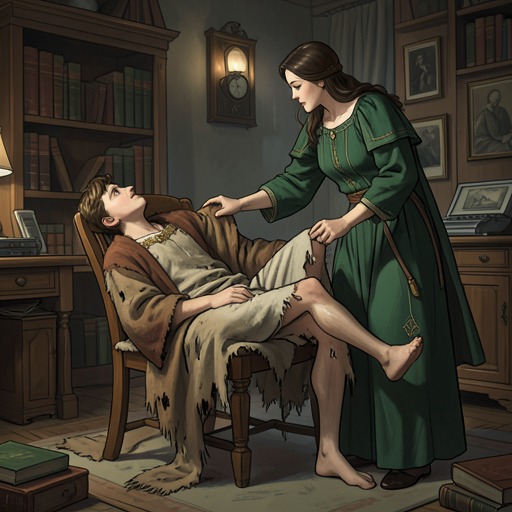
The chair stands in a chamber behind the concealed entrance curtain, with the main door shut when the rescuers return. The knight is fastened to it at his ankles, knees, elbows, wrists, and waist. Sweat beads on his forehead, and anguish shows on his face. The many points of restraint make the chair a device that controls his whole body, not simply a seat or a single fastening.
The captive explains that the danger recurs nightly. In his account, the fit will come, and he may plead or threaten his companions to undo his bonds, invoking what is most dear or dreadful to them. They must not trust those appeals: while he remains tied, they are safe; once out of the chair, fury may come first, followed by transformation into a loathsome serpent. The chair therefore imposes a cruel condition on rescue. It confines him, but its continued hold also protects the people who might otherwise face the violence of his enchanted change.
The Captive’s Plea and the Chair’s Power
During the fit, the knight describes himself as buried alive beneath the earth, surrounded by the beings he calls Maggotmen. He cannot tell whether he has lived ten years or a thousand. His memory reaches toward the open air and a small pool in which the trees appeared upside down beneath a deep blue sky. That contrast between underground confinement and the remembered sky makes the chair’s power feel like more than physical immobilization: it belongs to the larger enchantment that has cut him off from his former life and confused his sense of time.
When the fit lifts, he says he is sane every night and that release would let him remain a man. He insists that the rescuers are not his enemies or prisoners, and that the warning they have heard about his becoming a serpent is a lie. Yet this lucid plea collides with his earlier account of what he may do once free. He presses them to cut the cords, while Puddleglum tells the children to stand firm. The chair becomes the physical centre of a decision made under uncertainty: leaving it intact preserves a dangerous enchantment, but freeing the knight means acting despite the threat he himself has described.
Cutting the Bonds and Breaking the Chair
The decision turns when Jill urges the others to finish what they have begun. They take one another’s hands in farewell; by then the knight is screaming, with foam on his cheeks. Puddleglum and Eustace draw their swords and approach him. Invoking Aslan, they methodically cut the cords. The act releases the prisoner, but it does not end with his escape from the seat: in a single bound he crosses the room, takes up his own sword from the table, and draws it.
He uses that sword first against the chair. Its blade cuts through the silver as easily as string, leaving only twisted fragments on the floor. The break is accompanied by a bright flash, a sound like small thunder, and, for an instant, a loathsome smell. Those abrupt effects give the chair’s destruction the character of a magical rupture: its material body is shattered, and the force invested in it announces itself as it disappears. The knight calls it a vile instrument of sorcery and says it must lie there so that its mistress cannot use it on another victim.
Consequences and Significance
After the chair breaks, the knight turns to examine his rescuers, and whatever had seemed wrong in his face has vanished. The sequence links his recovery directly to two actions: the friends cut the cords that hold him, then he destroys the silver object that sustained his captivity. The distinction matters. Release from restraint frees his body; smashing the chair rejects the possibility that it can be used again to bind another victim.
Before the chair is broken, it is a stark, visible obstacle around which the companions must judge competing claims and risks. Its destruction makes that concealed conflict suddenly material: silver becomes fragments, and the brief flash, thunder-like sound, and foul smell expose the chair as a vehicle of sorcery rather than a neutral furnishing. At the same time, the scene does not treat the chair’s breaking as a detached display of power. It follows the rescuers’ decision to trust the captive’s lucid appeal despite their fear, and the newly freed man immediately directs his sword against the object that held him. The chair’s decisive function in the story is thus both coercive and evidentiary: it embodies the enchantment’s physical control, and its destruction confirms that the prisoner’s liberation has become a concrete change.